




Arizona Voters Show Growing Concerns Over Public Land Protections Heading into 2026 Elections
Results from Colorado College’s 16th annual State of the Rockies Project Conservation in the West Poll released today show widespread concern among Western voters about rollbacks of protections for land, water, and wildlife and cuts to funding for public land management. The poll, which surveyed voters in eight Mountain West states—Arizona, Colorado, Idaho, Montana, Nevada, New Mexico, Utah, and Wyoming—found that Western voters across party lines are prioritizing conservation, recreation, and renewables over fossil fuel development heading into this year’s midterm elections.
Highlights from the Poll
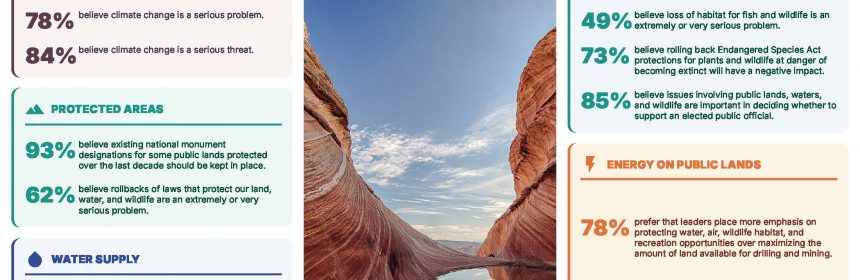
● 91% of Western voters say existing national monument designations should be kept in place.
● 84% of Western voters say that the rollback of laws that protect our land, water, and wildlife is a serious problem, a sharp increase from prior years.
● 85% of respondents say issues involving public lands, waters, and wildlife are important in deciding whether to support a public official.
● 86% of Western voters deem funding cuts to public lands a serious problem, including 76% of Republicans.
● 76% of Western voters—more Western voters than ever before—say they would prefer their member of Congress to place more emphasis on conservation and recreation on public lands over maximizing energy production.
● 74% of Western voters oppose selling some national public lands for oil and gas development.
As policymakers look ahead to the upcoming midterm elections, 85% of voters in Mountain West states say issues involving public lands, waters, and wildlife are important in deciding whether to support a candidate.
The poll surveyed at least 400 registered voters in each of eight Western states (AZ, CO, ID, MT, NV, NM, UT, & WY) for a total 3,419-voter sample, which included an over-sample of Black and Native American voters. The survey was conducted between January 2-18, 2026 and the effective margin of error is +2.4% at the 95% confidence interval for the total sample; and at most +4.9% for each state. The full survey and individual state surveys are available on the State of the Rockies Project website.
