




As Coconino County’s wildfires approach control, what’s ahead?
Arizona Daily Sun (August 15, 2025) by Sam McLaughlin
A month after two major fires roared into life in northern Coconino County, the end of active firefighting operations seems to be finally approaching. The White Sage Fire has been contained after burning almost 60,000 acres, and the Dragon Bravo Fire, though still active in some areas, is slowly coming under control: as of Wednesday, Aug. 13, containment was up to 44%.
What happens next?
For the White Sage Fire, the process of postfire assessment and planning has already begun. A Burned Area Emergency Response (BAER) team from the U.S. Forest Service began surveying the burn scar on July 31, focusing on conditions that could create immediate dangers such as postfire flooding or debris flows.
Paul Brown, the team’s leader, said via email that BAER assessments generally begin before total containment and are completed within about 14 days.
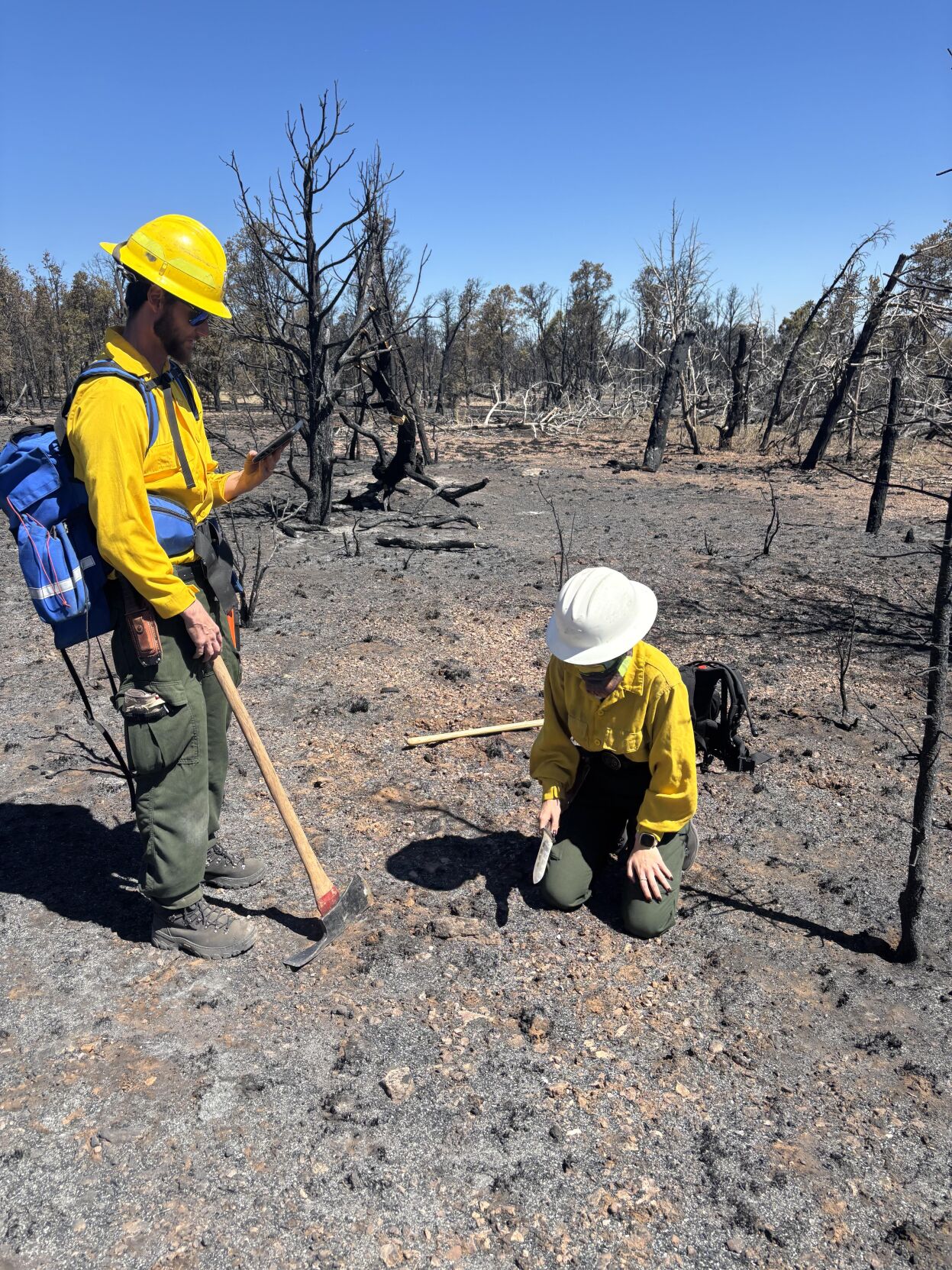
The team starts with a map of burn severity generated from satellite imagery of the fire area. It then helps them to focus their on-the-ground evaluations. There is a lot of ground to cover, and the team was working 12- or 13-hour days, according to Brown.
“Team specialists travel with vehicles to locations where there are critical values that need to be documented and evaluated,” Brown explained. “Some specialists, such as for heritage and recreation, do considerable travel on foot, if the critical values they are evaluating are in remote areas.”
One of the major questions in the aftermath of a fire is how the area’s hydrological characteristics might have changed. As Flagstaff learned in the wake of the Museum, Tunnel and Pipeline fires in recent years, a fire’s impacts on ground cover and soil characteristics can turn previously tame drainages into serious flood hazards.
“Soil scientists carry equipment in the field, such as a soils knife, to carefully examine soil characteristics, such as root condition and soil structure,” Brown said, “and a small water bottle to place water drops on the soil to determine if water infiltration characteristics of the soil have been altered from the fire.”
Their findings help other members of the team generate hydrological models of local watersheds, combining data on soil stability, slope angles and catchment area to predict runoff, flooding or sedimentation impacts. In turn, those models help land managers decide what emergency stabilization measures may be needed.
Teams also check on the condition of other resources within the fire’s footprint, including roads, trails, livestock infrastructure — such as tanks and fencing — and known archaeological sites.
The White Sage Fire BAER team met with the Kaibab National Forest to provide its recommendations on Monday, Aug. 11. (At the time of publication, details of those recommendations were not yet publicly available.) But the BAER assessment is only a first step toward understanding a fire’s long-term consequences.
“A lot of the stories written about fire events are right when they happen, or shortly after the fire’s done burning — the first few weeks,” Kyle Rodman, a research scientist with the Ecological Restoration Institute (ERI) in Flagstaff, said. “We often don’t really know the full ecological effects of a fire for a couple years or more.”
Depending on the type of vegetation present and the intensity of the fire, resprouting might begin as soon as a few months after the fire dies. Rodman said oaks and aspens are often quick to regrow. But other effects, like delayed or indirect tree mortality, could take years to fully manifest.
Although a fire’s total acreage is often the most widely shared piece of information, Rodman cautioned that size alone is not necessarily a good indicator of a fire’s impact. As an example, he pointed to the two largest fires in Arizona’s recorded history: the Wallow Fire, which burned 538,049 acres in 2011, and the Rodeo-Chediski Fire, which burned 468,638 acres in 2002.
“The Rodeo-Chediski Fire burned pretty severely, in a lot of cases,” Rodman said. “The Wallow Fire was a bit more moderate, but it was actually a bigger event. … So if you’re thinking about ecological effect, the Rodeo-Chediski probably had a bigger ecological effect than the Wallow Fire, just based on the patterns of severity.”
John Paul Roccaforte, another ERI researcher, said his experience conducting postfire studies has taught him not to assume that all the ground within a fire’s footprint will be devastated. In the case of the Dragon Bravo Fire, Roccaforte said he assumes at least some areas within the perimeter have burned at a relatively low intensity.
“Maybe the firefighters on the ground have an idea, but my guess is it won’t be 100%, everything gone, type of thing,” Roccaforte said.
Additionally, judging a fire’s physical effects requires an understanding of the ecosystem where the fire occurred, and how fire historically functioned in that ecosystem. As Rodman put it, “Is the fire burning within the range of conditions that the forest is capable of dealing with?”
For the Southwest, where forests are typically adapted to higher-frequency but lower-intensity fire, one concern is that high-severity fires could create “very large treeless areas … on a scale that is greater than these trees can recover from,” Rodman said.
If the area of tree mortality exceeds the neighboring trees’ seed dispersal range, it might take multiple generations for the forest to regrow in that space — if it happens at all.
On the other hand, when wildfire approximates the historical fire regime of an area, it may have beneficial effects, reducing ground fuels and tree density and thus reducing the likelihood of more intense fire in the future. Whether that will be the case for the North Rim or the Kaibab National Forest remains to be seen.
Let it burn?
But fire can have political consequences that spill over into ecological ones. It is rare for a prescribed or managed fire to jump containment, happening in fewer than 1% of cases. When it does happen, though, strong negative reactions from the public may prompt land managers to pull back on their use of fire on the landscape.
And for national parks in particular — where logging or mechanical thinning activities are often prohibited or tightly restricted compared to other federal lands — that can be an obstacle to effective forest management, Roccaforte pointed out.
Researchers have found that the most effective method for fuel reduction and fire mitigation is a combination of thinning and burning. If that combination isn’t possible, either method alone can be beneficial.
“Generally, national parks are more reliant upon fire as a tool,” Rodman said. “They’re also more likely to let fires burn; that’s been Park Service policy in a few places for many years now.”
Compared to other areas of the Southwest, the North Rim has maintained a highly active fire regime for decades, he added.
Rodman understands why escaped fire generates such strong emotions for nearby communities. He has relatives in New Mexico for whom the memory of the Calf Canyon/Hermits Peak Fire — a prescribed burn that escaped control in 2022 and became the largest blaze in the state’s history — is still fresh.
“They don’t want to see fire used on the landscape at all,” he noted.
Like many people here, I am flattened, utterly devastated by the destruction caused by the D…
But he hopes the Dragon Bravo Fire won’t lead to a similar moratorium on the use of managed fire, especially where other methods of fuel reduction are constrained. There is a consensus among fire scientists that increased suppression will ultimately lead to more catastrophic wildfires, not fewer, and that despite the risks, fire is a necessary component of active forest management.
“It’s a really important tool, and it’s a really important part of ecosystems in the West,” Rodman said.
While the ecological effects of fire may take time to thoroughly assess, the economic impacts of the Dragon Bravo Fire have already become apparent. The closure of the North Rim has put a serious dent in seasonal revenue for tourism-dependent businesses in northern Coconino County. Postfire assessments are likely to be key to determining which areas of Grand Canyon National Park can safely reopen, and when.
Any elevated risk of accelerated water runoff in the canyon’s major drainages could be cause for concern. Phantom Ranch, for instance, is a popular destination or stopover for rim-to-rim hikers, backpackers, mule rides and rafters. But it also sits at the bottom of Bright Angel Canyon, below the burn scar of the Dragon Bravo Fire, and could be vulnerable to flash flooding if the fire has substantially altered the upstream hydrology. (Bright Angel Canyon and the ranch have experienced flash floods in the past.)
So far, park officials have been reticent to speak about any predictions for the future.
“Because this remains a very active incident, there is currently limited information available regarding structural assessments, cultural resource impacts, or long-term recovery planning,” Joelle Baird, public affairs officer with the Grand Canyon National Park, wrote in an email on Aug. 4. Baird did not respond to a follow-up inquiry.
To read the article online, click here.
