


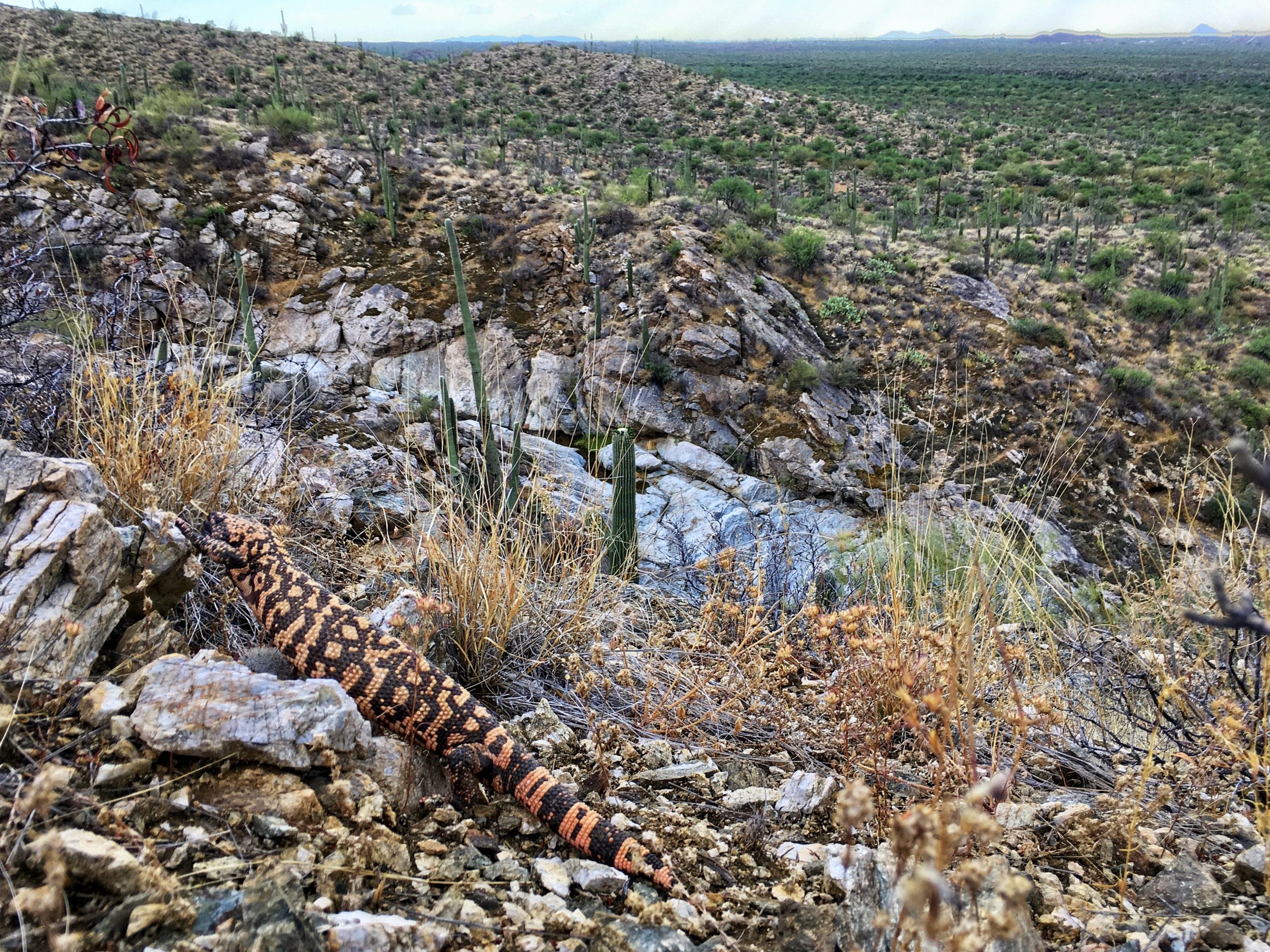


On the Arizona Trail, rough tracks and changing climate test the limits of people and land
Arizona Republic (Dec 1, 2025) by Joan Meiners
Day 30, Mile 683 (Passage 11e: Pusch Ridge Wilderness Bypass)
At the top of the climb up Mount Lemmon to Summerhaven, I hit a limit of low temperatures I was equipped to survive with the layers I had carried with me nearly 700 miles across the state. So I booked a night indoors, then set out the next day to reach the summit at 8,300 feet before starting down the south side of Tucson’s most notable peak.
From the radio tower near where the Arizona Trail bike and equestrian route links up with the Bigelow Trail to descend through Sabino Canyon, I could see zig zags of the road I had climbed from Peppersauce Campground the day before. The spot where I stopped in the shade to refuel. The bend where I dunked my shirt in a small stream to cool off. The sunny patch where I passed a dirt biker, stranded by leaking oil, waiting for a ride. (I was glad my bike’s engine runs on candy and pepperoni.)
The front side of Mount Lemmon was stunning and treacherous. I can only describe the trail through much of this passage as “rocks on top of rocks,” with views that offered some compensation for the struggle. I reached Gordon Hirabayashi Campground well after dark.
Day 31, Mile 703 (Passage 10: Redington Pass)
The next passage, a climb out of Molino Basin, brought little relief. With cows as my witness, I spent the day lifting my bike up and over rock ledges on 20% grades at speeds so slow my bike computer didn’t acknowledge that I was moving. I watched a red and black velvet ant — not actually an ant, but a wingless wasp known as a “cow killer” due to the intensity of its sting — crawl across the trail, and wondered if I would trade my current pain for the challenge of its venom.
After leveraging my bike inch-by-inch for hours through the Mazatzal Mountains, then again in the upper Gila River Canyons, and yet again through the Tortilla Mountains, I knew I could. But I was nearing my breaking point of this whole project seeming like a fun idea anymore.
I pitched my tent at a high point with a view of the Tucson lights but zero bars of cell service — a strange juxtaposition of staring at the grid while being off it. I was serenaded to sleep by the squeaky territorial howls of grasshopper mice.
Day 32, Mile 715 (Passage 9: bike bypass route around Rincon Mountains)
The next day, I dropped onto a dirt road bike bypass of the Rincon Mountain wilderness. It ushered me past a sign welcoming visitors to the Coronado National Forest, by campers huddled around fire rings and through Rincon Valley, where I stopped at a small roadside bar to fill up on water. When the bartender asked if he could get me anything to drink, at 11 a.m., I asked if he might, by chance, be able to whip up a milkshake? No one had ever asked him that, he said, before disappearing into the back for a while and emerging with a chocolate concoction of creamy calories.
From there, Colossal Caves Mountain Park was just a 7 mile coast down the paved road. But the bike route took a 270-degree turn back north to rejoin the Arizona Trail in Saguaro National Park. I eyed the shortcut before putting my tired legs to the task of staying on course. I didn’t want to miss the aged, armed giants that had inspired federal protection.
Fifteen miles of hero dirt on smooth desert singletrack and some stirring old succulents later, I arrived at Colossal Caves from the north on the trail. As storm clouds hastened the darkness, I rolled out my sleeping pad on a picnic table under the large roof of a group site.
Michelle Cathey, a thruhiker from Flagstaff, had the same idea and we talked in the open-air shelter as we dug out our headlamps. A retired schoolteacher, Cathey was hiking in honor of fellow Flagstaff schoolteacher Dale Shewalter, who she had worked with and who facilitated the creation of the Arizona Trail before dying of cancer far too early, she said.
I don’t know if Cathey heard the frantically screech-barking coyote circling nearby later that night. But a friend who had joined me for the night from Tucson and I spent a while sitting up in our sleeping bags on the picnic tables, squinting into the dark, wondering if this was the moment I would use my bear spray.
Day 33, Mile 757 (Passage 8: Rincon Valley)
With decent cell service at the park, I lingered late at the picnic area finalizing my dispatch for the next week on my iPad while heating up more water from the spigot (so easy!) for second and third cups of camp coffee. Compared to past on-trail writing spots from sloped hillsides with spotty service, it felt luxurious.
As a result, I didn’t get rolling until the storm was upon me. I made it five miles, then took shelter under an awning at Gabe Zimmerman Trailhead. I had planned to go another 15 miles that day. But the dreary skies, sideways rain and my weather app all promised certain doom. So when a resident of Vail offered me a roof for the night that was enclosed by four walls, I accepted. We all have our limits of what we can sustainably tolerate.
Listening to the heavy downpour from their guest house that night, I knew I had lucked out with the invitation. Storms are inevitable, and often bring relief to drought-challenged desert life.
But within an atmosphere supercharged by fossil fuel emissions that trap heat energy, they have shifted stronger and less predictable. Trails built to be stable through normal (pre-2000) weather patterns can be damaged by modern extreme events, as I saw during my first week on the Arizona Trail, where climate-intensified megafires near the North Rim of the Grand Canyon caused widespread tree downfall and closures in anticipation of mudslides.
Abnormal rain, hail, heat and cold (another result of human-caused atmospheric instability) also erode the resolve of even the most determined travelers. I later learned that Cathey, the Flagstaff schoolteacher, spent this unusual hailstorm — which made news and prompted flood warnings — shivering away her energy inside a frozen tent.
And while I stayed dry through the worst of it, the delay set me up for a grueling two days of making up miles.
Day 34, Mile 762 (Passages 7 and 6: Las Cienegas and Las Colinas)
Mike, my host in Vail and a former search-and-rescue worker who knows well the struggles on the Arizona Trail, took me back to the Gabe Zimmerman Trailhead while it was still raining with a “feels like” temperature of 37 degrees.
“You sure about this?” he asked as he helped unload my bike from his truck. “You could stay and wait out the storm.”
I’m not sure about any of this, I said as I thanked him. But I’m going to get today’s task started anyway.
I pedaled through the drizzle to a ridgeline view of traffic on Interstate 10, then descended through the “snake tunnel” beneath it. Past the Sahuarita Road Trailhead, I climbed a steady 2,500 vertical feet on splashing singletrack.
It rained until about 2 p.m. I pulled aside for a hiker heading north and we exchanged a grimaced greeting from under dripping coat hoods. Then the sun came out and the trail surface glittered. Thorny plants that had grabbed at me as I gripped wet handlebars took on a transcendent glow. Each rock transformed from slick obstacle to shiny treasure.
Drinking in my surroundings, I too felt rain-refreshed. But the desert harbors infinite quick tricks, and as the terrain dried while the temperature soared, weeks of cumulative fatigue set in.
With hours of riding still between me and my interview appointment the next day at Kentucky Camp with Matt Nelson, the Arizona Trail Association director, I neared the end of my patience with what Nelson calls the “accordion landscape” — where each repetitive steep and rocky fold demands an expansion of energy to ascend followed by a dispiriting contraction of that progress down the other side.
As the sun sank low in the sky and my sweaty clothes turned from a consequence of heat exposure to a liability in the midnight cold, I reached a tipping point.
So — I won’t lie to you — I bailed out on a dirt road to State Route 83, did a few less brain-rattling miles on the smooth pavement, then followed another dirt road back to the trail. It didn’t save me any mileage or much climbing. But it did temporarily rescue my sanity. And it might have spared my shoes: My first pair had already split in half at the sole after being subjected to more hiking miles than they could endure.
Almost everything has a tipping point. If pushed beyond it, the chances of a full recovery dim. In nature, tipping points have been defined by scientist members of the Intergovernmental Panel on Climate Change as critical thresholds in average warming of the Earth’s atmosphere that, if exceeded, will trigger rapid destabilization of planetary processes like monsoon rainfall patterns, glacial melting and ocean currents.
Scientists have debated how much unnatural warming — built up in greenhouse gases released by burning fossil fuels — is likely to tip us into disastrously unmanageable weather systems. For years, 1.5 degrees Celsius, about 2.7 degrees Fahrenheit, over the pre-Industrial global average was the danger zone. In 2024, the world breached that boundary and, as predicted by science, recorded unprecedented weather extremes across the planet that wreaked deadly and expensive havoc on human infrastructure, agriculture and ways of life.
As we now trespass toward 2 degrees Celsius of average warming in a world where the United States, the most carbon polluting country in history, did not participate in last month’s global climate conference, there is much debate about how to brace for these changes. But no one credibly doubts that safe climate thresholds exist or, as a study concluded earlier this year, that modern policies and practices push us ever closer to them.
Day 35, Mile 795 (Passages 5 and 4: Santa Rita Mountains and Casa Blanca Canyon)
Kentucky Camp, a former gold mining site along the Arizona Trail, offers its own lesson on what happens when humans test the limits of what nature can provide.
Volunteer hosts Jeff and Kim Crandell welcomed me with warmth when I rolled up between the old, adobe buildings on an overcast, chilly day. They showed me the former mining engineer’s cabin and Kim shared its backstory.
In the early 1990s, James B. Stetson and collaborators invested hundreds of thousands of dollars, an unfathomable fortune, in canals and pipes to bring in enough water for hydraulic mining, the best way to pull gold flakes from the Santa Rita Mountains’ low-quality ore. But they only managed to extract a few thousand dollars in profit. The operation was eventually abandoned — as spent mines so often are — until the U.S. Forest Service restored the area as a national historic site.
I was chatting with the Crandells about the scars humans leave on the land while trying to exert mastery over nature when Matt Nelson rolled up with his mountain bike, accompanied by Arizona Republic photojournalist Mark Henle. Both men have seen their fair share of unruly and inhospitable Arizona environments evading attempts at control.
I sat down for an interview with Nelson about limits on a changing Arizona Trail and where the line is between what he, as its executive director, can do to manage them versus where opportunities to preserve the experience for future generations may tip beyond his reach.
Nelson worries about carrying capacity — a term ecologists use to estimate what an area can sustainably handle long term. It can also be applied less formally to the physical limitations of an average Arizona Trail user: typically inexperienced college kids or retirees wanting to get out while they still can.
The larger temperature swings, worse drought and stronger storms associated with climate change threaten to render the already-extreme trail off limits for people who’d rather not carry 16 pounds of water through drier sections or enough layers and gear to keep them safe in events beyond the unnatural downpours that melted my path into mud and froze Michelle Cathey inside her tent.
Nelson also sees recent attempts by the Trump administration to increase the number of cattle on public lands as a risk to healthy land and the trail experience. This viewpoint is backed by recent research that found the impact of grazing on biodiversity and ecosystem functioning exceeds the sustainable capacity of drier grassland regions.
Although tanks for cattle currently bridge many gaps in water access along the Arizona Trail, Nelson is confident he could find funding for more rainwater collectors and stream improvement projects as replacements. Likely no one would miss the shared experience he calls “knowing what a cow’s butt tastes like.” Reduced grazing, he said, would also protect Americans’ trust that public lands are, in fact, being managed for the public.
The Arizona Trail Association’s survey of cross-state completions suggests that trail use is way down this year. My own surprisingly solitary experience so far seems to confirm this.
Nelson believes this decline may be the result of increasingly extreme weather conditions combined with increasingly extreme domestic politics and international relations.
While this light traffic obviates a need to plan for potential overuse, he worries most that this life-transforming resource for young adventurers and wisened self-seekers may vanish over a cliff of possibility.
“The Arizona Trail won’t get more popular as it gets hotter and drier,” Nelson said. “These long trails might be part of our history but not our future.”
To read the article online, click here.
