




On the Arizona Trail, saguaros, coati and a midnight skunk reveal resilient biodiversity
Arizona Republic (Nov 24, 2025) by Joan Meiners
Day 25, Mile 595 (Passage 15: Tortilla Mountains)
With Kearney’s Ray copper mine as my backdrop, I set off on my bike into the remote and wild Tortilla Mountains from Kelvin Trailhead. Loaded with seven liters of water and six days of food to get me through the next stretch, my bike was the heaviest it’s been on this journey.
But with a newfound shoulder strength forged from pushing close to my own body weight up steep hills across two-thirds of Arizona so far (what am I going to do with this particular ability after this?), I was feeling ready for it.
The midday heat quickly sapped that confidence. It’s amazing how just a few additional degrees under full sun can change a landscape from dazzling to daunting. After a couple of hours of slow progress up the punchy inclines alongside Ripsey Wash, I paused in the shade of an ironwood tree.
It wasn’t long before the crunch-skid-crunch of a gaggle of mountain bikers descending gravely switchbacks ahead surprised me.
Even though I’m on a state-sanctioned bike route, I had not encountered anyone else choosing to conquer this terrain on a bicycle since I had crossed paths with the (certifiably unhinged — read: awe-inspiring) Arizona Trail racers above the Mogollon Rim. And I had yet to meet anyone at all doing what I was — attempting to ride the length of the state on remote, often technical trails, self-supported with full camp gear and mostly alone. Despite my two decades of mountain biking experience across the Southwest, the Arizona Trail’s sticky peanut-butter mud, 35% grades, water scarcity and terrain capable of rattling a rear wheel right off were showing me why.
Leif Abrell, Igor Baraja, Brian Leddy and Ira Getraer were not bikepacking, but were out for a long day ride. They knew well what they were getting into — Barash is a steward for passage 16, the one down to and up from the Gila River that had jostled my thru axel loose, and Abrell stewards passages 14 and 12, which I’d be tackling on my ascent of Mount Lemmon in a few days. The crew had a fifth member, but he’d gone ahead after breaking his chain, a toll paid to the Arizona Trail gods that made all too much sense to me now.
The others stopped to chat. I asked, as I do, whether they felt climate change was affecting their trail experience. We all agreed that, at 81 degrees in November, it felt unseasonably warm.
Barash mentioned invasive grasses — enabled by warmer, drier conditions — giving way to worse wildfires that flame from flickers to conflagrations much more easily than in the past. He mentioned the Telegraph Fire, sparked by a flare dropped during an Air Force training event in 2021, that burned Pinal Peak just north of where we stood and caused flooding in Globe.
Abrell, who happens to be a research scientist at the University of Arizona, agreed, adding that “along the Beeline Highway there, those cacti probably won’t come back unless humans plant them.”
A heat-energized atmosphere is also complicating trail stewardship, he said.
“We do treadwork (trail surface stabilization), and there’s going to be a lot more of that with big storms from climate change,” Abrell said. “Yeah, we know everything changes over time, but now it’s faster change over time.”
I recalled talking to a cactus specialist at the Desert Botanical Gardens last year who told me about an effort to cultivate an endangered hedgehog cactus in the greenhouse and then hike it out to replant on slopes of its narrow habitat range near Globe that had burned in the Telegraph Fire. Contrary to the reputation cactuses have for being hardy in extreme environments, their slow-growing existence at the edge of what is possible in nature means they are actually quite sensitive to higher temperatures and setbacks related to stronger storms, fires or drought, Raul Puente-Martinez had told me.
Determined to prove my own hardiness in extreme terrain, I said goodbye to the bikers heading downhill and continued my push up toward the ridgeline. Camp spots beckoned as the sun dipped. But I promised myself I wouldn’t stop until I hit 10 miles for the day, which — considering the 2,500-foot ascent, technical terrain and heavy load — felt hard-earned.
Day 26, Mile 605 (Rest of Passage 15: Tortilla Mountains)
I got started early to make up miles. But after missing the turnoff to a water source just 20 minutes into the day, I was backtracking up a wash on foot when I spotted a backpack dropped like fruit below a mesquite.
Thruhiker Thaddaeus had already passed me that morning (apparently his definition of early is different than mine), and our paths were now converging at the watering hole.
As we filtered and treated water, I asked how his hike was going. He said he had been surprised at how the Arizona Trail doesn’t seem to follow the natural contours of the landscape but insists, like a toddler not wanting to miss a single view, on going up over every ridgelet and down into every drainage. He’d opted for short detours along washes and dirt roads that connected him back to the trail more gradually. We realized that was why I hadn’t seen him pass me and why he’d found the water source without any trouble.
I laughed, stretching my shoulders, and wondering aloud about the wisdom of my allegiance to the official route.
He described himself as “bikepacking-curious,” but said he’d been glad to be on foot on this trail. Everyone he’d seen with a bike had been walking it. As I pondered whether that made me feel solace in solidarity or inducted into a cult of senseless suffering, Thad shouldered his pack and went on ahead.
A few miles later, the terrain topped out and he stepped aside as I passed, reveling in the opportunity to pedal.
This rideable terrain continued, gloriously, the rest of the day. I cranked through the remainder of passage 15, which ended at another Arizona Trail Association rainwater collector, and into passage 14. Here, the Black Hills escorted me into an enchanting dense forest of cholla cactus, their sturdy yellow spines catching the day’s fading glow.
Day 27, Mile 630 (Passage 14: Black Hills)
The next morning, Thad caught up with me, of course, as I was drinking coffee and picking stubborn cholla spines out of my right hand. Magical in daylight, the notoriously aggressive cactus had become menacing without it.
Riding into the warm night had seemed like a good idea. But darkness distorts depth perception. And after misjudging my clearance and ramming my wide handlebars into Velcro-like clusters of desert needles more than once, I’d pitched my tent on the nearest flat spot.
Thad whipped out his sitting pad and joined me. We talked about what other long trails we’d both done — he’s a “triple crowner,” someone who has completed the Appalachian Trail, the Pacific Crest Trail and the Continental Divide Trail, an impressive feat. (I’ve done sections of the Appalachian as well as the John Muir Trail and a few long walks in Scotland and Ireland.)
We agreed that these trail networks seem to bring joy even to people who never get out onto them. An insatiable appetite for stories of adventure and a desire to imagine the possibility wild spaces hold may be as core to human nature as the shelter, company and comforts we’d left behind in search of this.
It reminded me of the conversation I’d had near the Mogollon Rim with naturalist Tom Fleischner about wildlife having, in addition to their own right to exist, value for humans who marvel in just knowing that captivating creatures are “out there.”
Arizona’s Sky Islands, the collection of distinct peaks that punctuate Tucson area lowlands, are known for their biodiversity. The columns of habitat up and down the elevational gradients of skyscrapers like Mount Lemmon and Mount Graham provide refuges for species who fail to survive in the desert below, or who are escaping rising temperatures related to climate change. Some, like a critically endangered Mount Graham Red Squirrel, are found nowhere else.
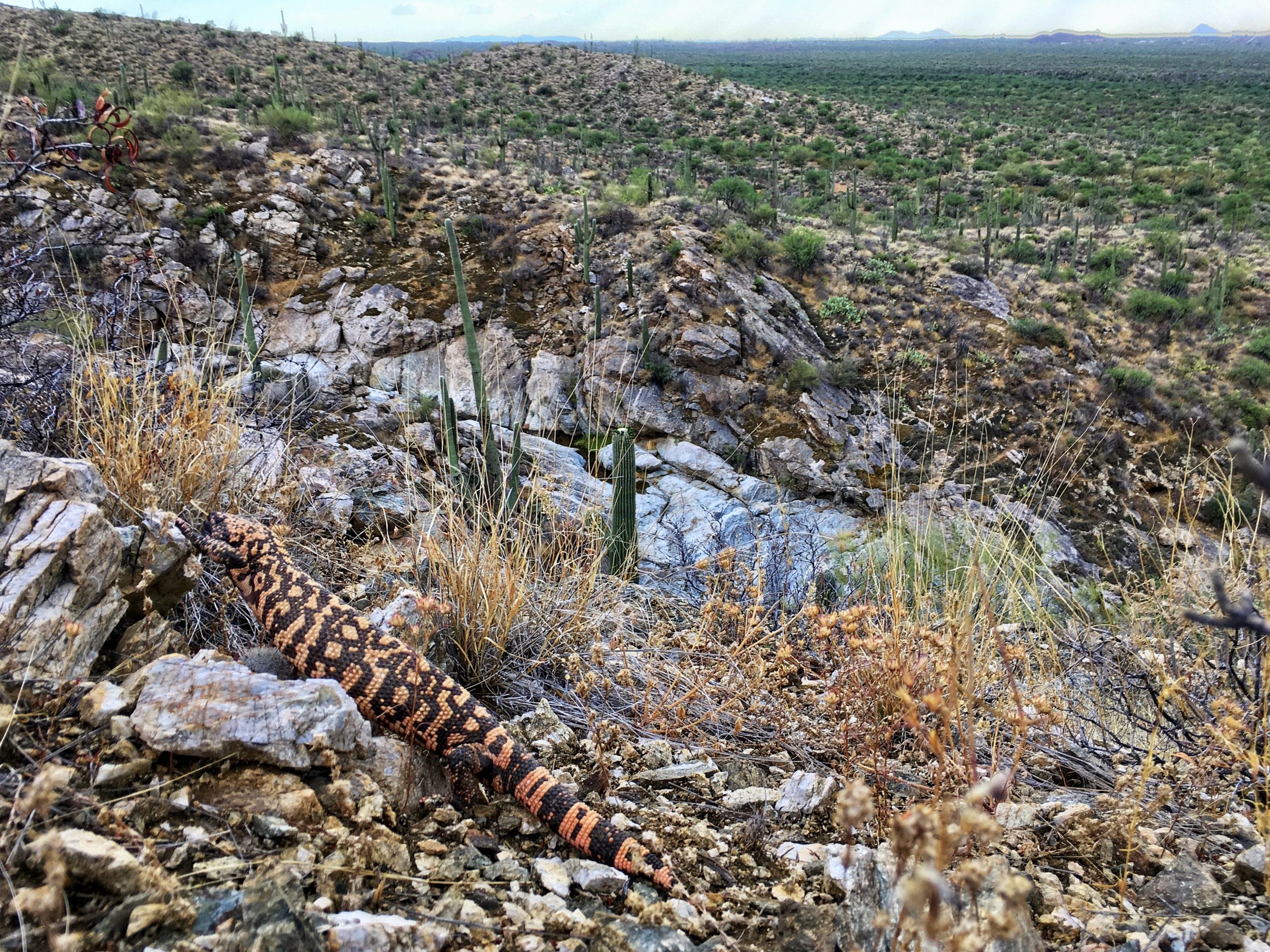
As I continued on the Arizona Trail toward Mount Lemmon, I started to see more wildlife than earlier on the trip, when sightings had mostly been of deer or elk. I nearly ran over a gopher snake stretched, camouflaged, across the trail. A mile later, a desert tortoise was parked in my path. When I next leapfrogged with Thad, he told me he’d seen a Gila monster.
In the heat of late afternoon, I stopped at a tank where hikers had devised a system to get water that involved climbing a ladder and lowering a long stick with a water bottle taped to it into the pool. Then I rode another couple of hours to camp near a windmill-powered tank that appeared bone dry until you crawled under a grate and tripped a wire holding up a floater designed to prevent overflow. Once tapped, clear liquid poured out for waiting honeybees.
Day 28, Mile 645 (Passage 13: Oracle)
On my journey southward and skyward the next day, I noticed a pattern of thick saguaros on north-facing slopes, contrasted with scant representation of the species on adjacent south-facing inclines.
As a backcountry skier trained in avalanche safety, I know that in the Northern Hemisphere, north-facing slopes often have more stable snow because they don’t get the full intensity of midday sun that hits south faces. But it was remarkable to see such strong evidence of this temperature difference, and the saguaro’s sensitivity to it, on a dry landscape.
Back at Lost Dutchman State Park the previous week, I had spent an evening around the campfire with two friends from graduate school who now work as wildlife biologists for Arizona Game and Fish, Ryan O’Donnell and Stephanie Cobbold.
I asked them how worried they were about the ability of Arizona’s flora and fauna to adapt to climate change. Though they don’t specifically study this question and are instead focused on monitoring regional biodiversity and species ranges, O’Donnell’s sense overall is that ecosystems are resilient and species find ways to adapt or move if given enough time and stability to do so.
“For the most part, as species are shifting from climate warming, that doesn’t inherently threaten them,” O’Donnell said. “It’s change that’s caused by humans, but if the range is shifting and there’s a place for it to go, that in itself isn’t a threat. The problem is when there’s development and habitat loss and all these things happening at once that make it harder for species to adapt.”
Saguaros are an exception, Cobbold chimed in. Higher temperatures, drought and fires related to human-caused climate change are stressing adult survival and the recruitment of slow-growing replacements across the Sonoran Desert.
“With saguaros, it looks like just in the last few years there have been observed changes in mortality rates,” she said. “This is a species that is well adapted to the harshest conditions, and yet mature saguaros are not doing as well now and younger saguaros are having trouble establishing.”
At the Desert Botanical Gardens in Phoenix last year, I talked with botanists who were piloting an experiment to expand the use of shade cloths over saguaros, especially smaller, more vulnerable ones, to protect them from heat extremes. Even at a place where they cater conditions to cactuses, the gardens lost hundreds of plants, including many mature saguaros, during the July 2023 heat wave.
Climatic change not only affects Arizona’s most iconic plant, Cobbold added, but all of the species who rely on it. She has spent time surveying habitat in Mexico and southern Arizona for the cactus ferruginous pygmy owl, a subspecies that nests in saguaros. It was recently listed as threatened under the Endangered Species Act — with climate change and habitat loss mentioned as the primary obstacles to its survival.
“As it gets hotter and it gets drier, that’s just adding more stress to populations of ferruginous pygmy owls that are at the edge of the species range and therefore that are already not in the best situation,” she said from across the trailside campfire. “So that’s an important thing to think about, the stability of these populations.”
That night, as I approached my end point at Peppersauce campground along the alternate route for bikes on dirt roads up the north face of Mount Lemmon — which a half dozen people had urged me to take and I’d finally agreed — I spotted a coatimundi meandering in front of me. When it heard me, it skittered up a rock ledge and we took each other’s measure for what felt like a long moment, a blip in evolutionary time.
Day 29, Mile 662 (Passage 12b: Oracle Ridge)
The next day was a long, steady grind 4,400 feet up to Summerhaven atop Mount Lemmon. This felt vastly more manageable than the trail tantrums thrown at me by relentless technical switchbacks over the past few weeks, but was made more difficult by a uniquely terrible night’s sleep.
I had made dinner, stowed my food in the campground bear box and tucked myself into my sleeping bag when I heard a rustling in the fall leaves that I could identify as a medium-sized animal. Curious, I popped my head out expecting to see a raccoon but hoping for another coati.
Instead, I was greeted by a scavenging skunk. It spent most of the night skulking around my campsite, coming right up to my tent vestibule mere inches from my head at times.
I was equipped with bear spray. I felt comfortable scaring off a raccoon or a rummaging rodent. But I had no idea how to dissuade a skunk from potentially rendering all my gear unusable in the middle of a cold night where I had no cell service. So I just lay there silently hoping it would slink away.
Later, at a safe distance, I learned that there are four species of skunks in Arizona, more than any other state besides New Mexico, which also has four, and Texas, where all five species of skunks that occur in the U.S. can be found.
With the right amount of wild space between my face and all the fantastical beasts “out there,” biodiversity is one of the things I’m most thankful for.
To read the article online, click here.
